
The SC MEDICA philosophy
The least invasiveness and the least hardware needed to achieve the intended result. FFX® was designed around this principle.
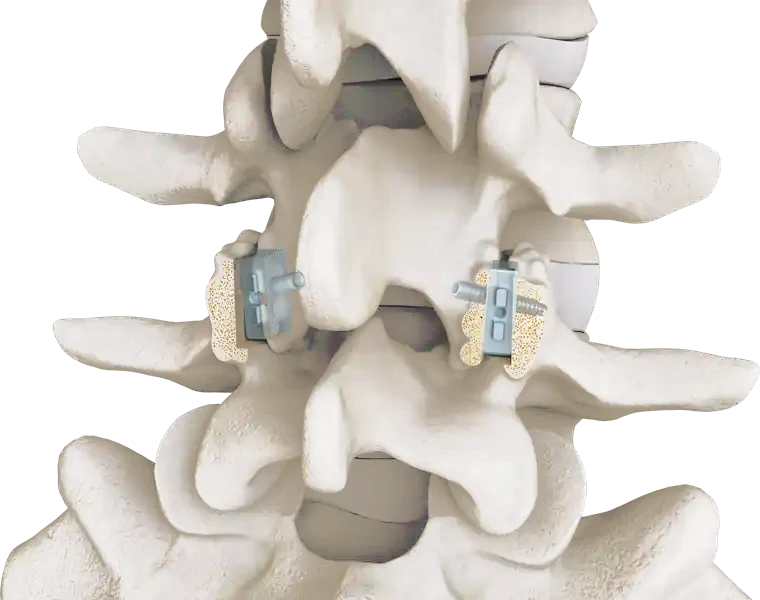
Stabilize what needs to be stabilized. Nothing more.
Conventional lumbar fusion was designed for major instability, deformity and extensive decompression. Many patients need far less: a stable segment and a fused facet joint. MiNVI asks one question before every implant: what is the minimum instrumentation that reaches the clinical goal?
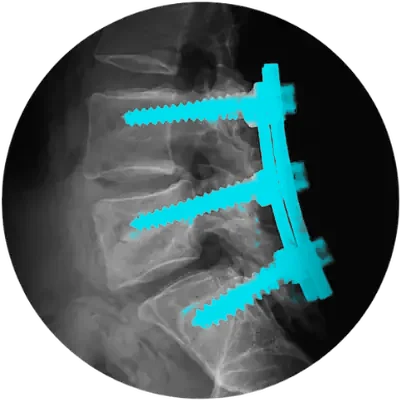
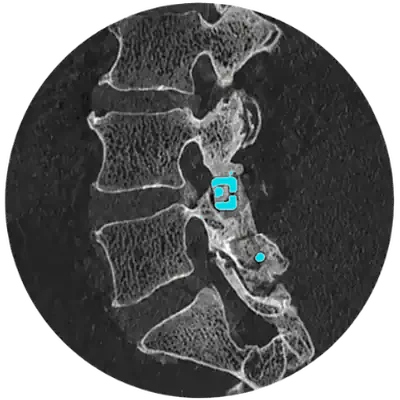
Only the implants the indication requires.
Smaller approaches, down to fully percutaneous.
A solid bony fusion, confirmed on CT scan.
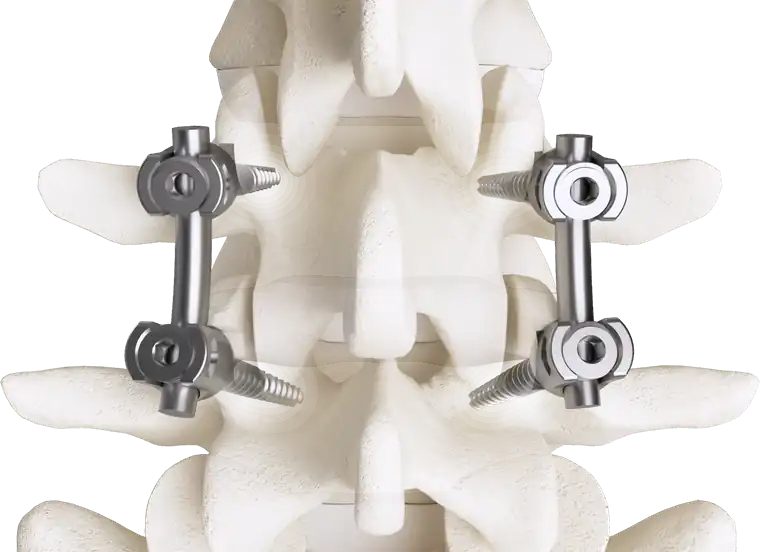
10implant components
4Pedicle screws
4locking caps
2rods
MiNVI
Minimum Necessary
Volume of Instrumentation
18×
4implant components
2FFX® cages
2FFX® locking screws
Implanted metal volume of a single-level construct, using the most frequently implanted sizes. SC MEDICA calculation.
MiNVI applied
A titanium cage is placed inside each facet joint and secured with an FFX® locking screw. The segment is stabilized and the joint fuses, without Pedicle screws or rods.
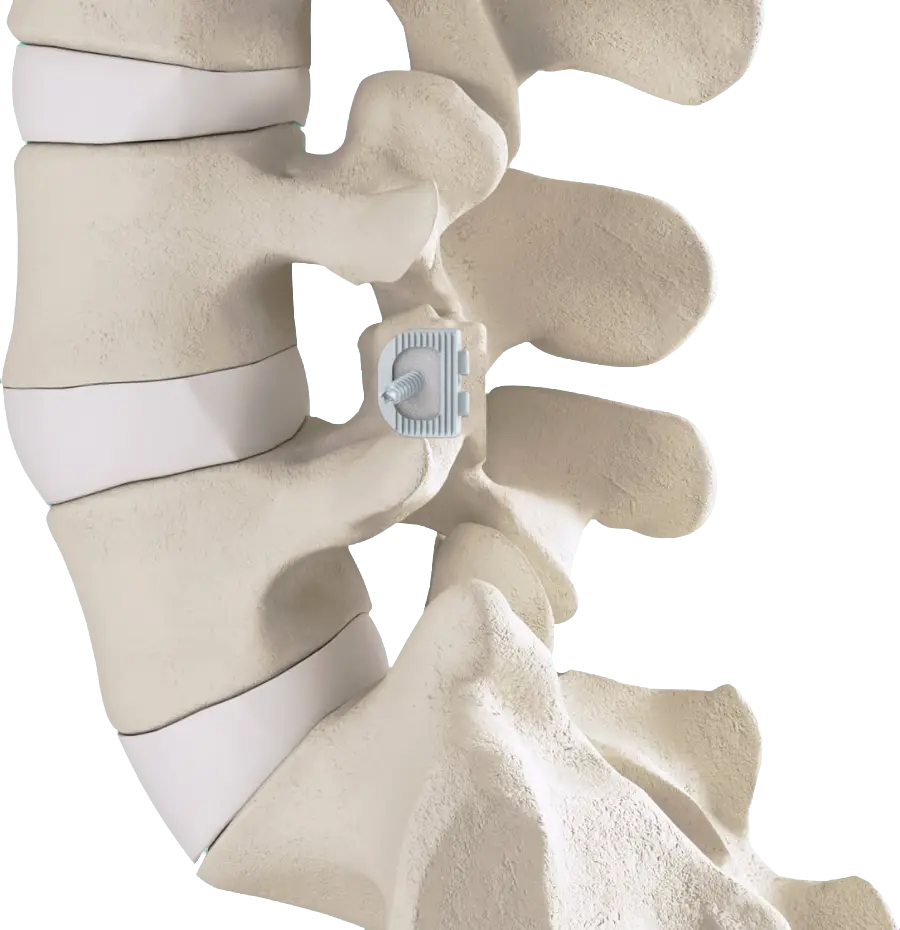
An alternative to conventional lumbar fusion
Compared with Pedicle screws, published studies of FFX® report:
operative time
99 vs 153 minblood loss
251 vs 447 mLfusion on CT scan
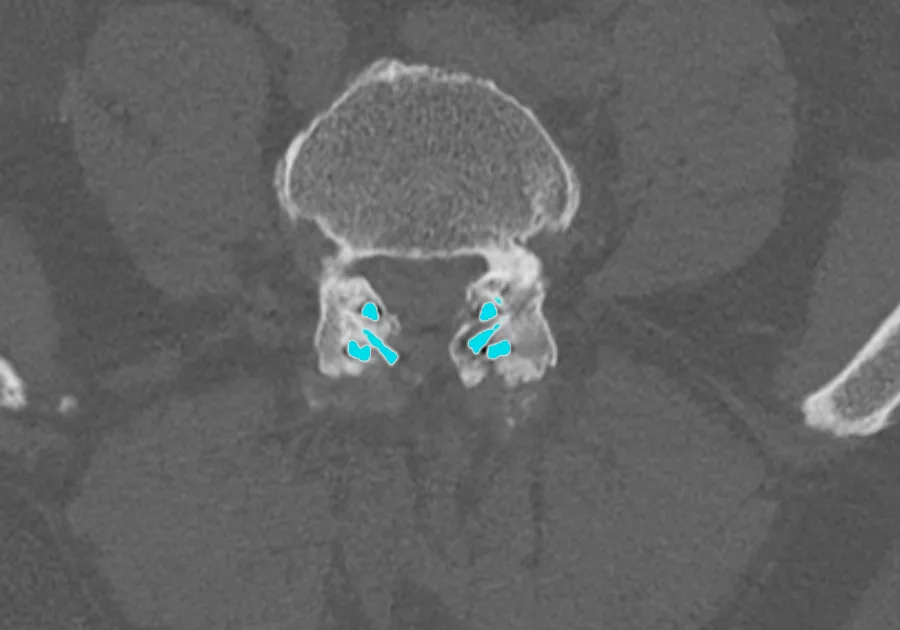
vs 85% bony fusion at 2+ years, equivalentreoperation
vs 10.7%, not significant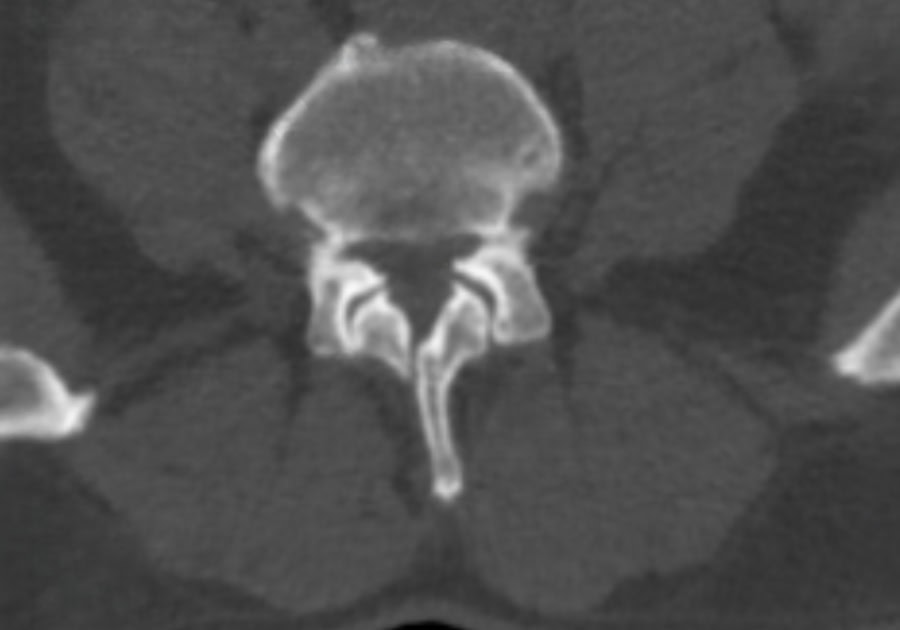
Srour, Cureus, 2022 (operative time, blood loss); Houari et al., Clin Spine Surg, 2024 (fusion, reoperation). See all clinical evidence
Minimal access, by design
Standard posterior approach, with decompression when needed.
Tubular access through a small incision.
Under endoscopic vision.
Fully percutaneous and tubeless.
The approach depends on the patient's anatomy, the associated decompression and the surgeon's training.
MiNVI has limits: grade II or higher spondylolisthesis still requires Pedicle screw fixation.
MiNVI stands for Minimum Necessary Volume of Instrumentation. It is SC MEDICA's design philosophy: use the least invasiveness and the least hardware needed to achieve the intended clinical result.
In practice, MiNVI places instrumentation only where fusion is sought. FFX® facet arthrodesis applies this principle to spinal fusion: the facet joints are stabilized and fused from the inside, without Pedicle screws or rods.
Yes, for degenerative conditions with up to moderate instability (grade I spondylolisthesis). Facet arthrodesis is a fusion, but a targeted one: instead of locking the segment from the outside with Pedicle screws and rods, FFX® fuses the facet joints from the inside.
In fact, a Pedicle screw fusion also aims for a bony bridge across the facet joints. FFX® goes straight to that goal, without Pedicle screws or rods.
In comparative studies, surgery was shorter (99 vs 153 minutes) and blood loss lower (251 vs 447 mL) than with Pedicle screws, with 91% fusion on CT scan at 2+ years (with the FFX® locking screw) and similar clinical improvement.
Pedicle screw fusion also increases the load on the adjacent levels, a recognized factor of adjacent segment disease (ASD). In a comparative study, most reoperations in the Pedicle screw group were for ASD. In a finite element study, stress on the adjacent facets was up to 15.7% lower with FFX® than with Pedicle screws before fusion, and adjacent disc stress was 7.7% higher with Pedicle screws.
Srour, Cureus, 2022; Houari et al., Clin Spine Surg, 2024; Simon et al., Int J Spine Surg, 2022.
Yes. Arthrodesis is the medical term for the surgical fusion of a joint: the two bones grow together into a single block of bone.
In the spine, "fusion" usually refers to fusing two vertebrae, either through the disc space (when an interbody cage is used) or between the transverse processes and facet joints, with Pedicle screws and rods holding the segment. Facet arthrodesis fuses the facet joints alone. With FFX®, the fusion is obtained directly where the motion comes from, inside the facet joint.
Both stabilize the facet joint, but in different ways. A traditional transfacet screw crosses the joint to hold it still, but does not fill the gap inside the joint. FFX® is a facet cage: it is placed inside the joint, filling the intra-facet gap, after the facet surfaces have been prepared with a rasp, and is secured with an FFX® locking screw. This design brings three advantages:
Better load distribution. In a finite element study, stress concentrated around the transfacet screw, whereas FFX® spread the load across the joint, which suggests a lower risk of loosening.
Facet preparation for bony fusion. Rasping the facet surfaces before placing the cage promotes bone growth across the joint.
Restoration of foraminal height. The cage gently opens the joint: mean foraminal height increased by 3.7 mm at 2+ years.
Simon et al., Int J Spine Surg, 2022; Houari et al., Clin Spine Surg, 2024.
A single-level FFX® construct (2 FFX® cages and 2 FFX® locking screws, 4 components) contains about 18 times less implanted metal than a single-level Pedicle screw construct (4 Pedicle screws, 4 locking caps and 2 rods, 10 components). And this calculation does not even include the interbody cage that is often added to a Pedicle screw fusion.
This is an SC MEDICA calculation based on the most frequently implanted sizes.
Yes. FFX® can be placed through an open, mini-invasive (tubular), endoscopic or fully percutaneous tubeless approach. The choice depends on the patient's anatomy, the associated decompression and the surgeon's training.
Higher-grade spondylolisthesis (grade II or more), gross instability and deformity still call for Pedicle screw fixation.
In these cases, adding FFX® to the Pedicle screw construct reduces the mechanical stress on the screws: by 57% in a short construct (L4-L5) and by 62% in a long construct (L2-S1), in a finite element study.
And FFX® does not prevent a subsequent Pedicle screw fixation, if one becomes necessary.
Saddiki et al., Int J Spine Surg, 2025.
As with all medical devices, there are risks and considerations to device use. Please refer to the device labeling for a full discussion of potential risks, contraindications, warnings, precautions, and instructions for use. The information presented on this website is intended only as a brief summary for visitor convenience. Not all products or indications are cleared in every country and may be subject to further local variations. For specific product information, you should always consult the local product documentation. For advice on medical issues, you should always consult your local medical practitioner.